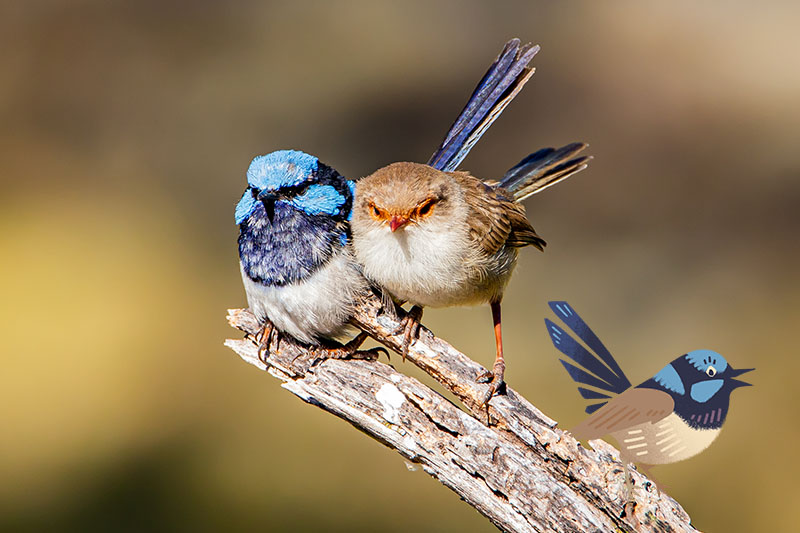
Superb Fairy-wrens (Malurus cyaneus) provide a compelling example of how animal behaviour often resists simple, binary interpretations. While they are socially monogamous and form visible pair bonds between a male and female, genetic evidence shows that reproduction within these groups is far more complex. A significant proportion of offspring are the result of extra-pair mating, where females mate with multiple males. This leads to broods with mixed paternity, meaning care, reproduction and social bonding are not confined to a single pair. [1,2].
By mating with multiple partners, females can increase genetic diversity within their offspring, which may enhance survival. At the same time, multiple males may contribute to care or provide protection, even when paternity is uncertain. This creates a system where parenting roles are shared and not strictly tied to genetic ownership [3].
The species also challenges assumptions about how sex and identity are visually expressed. During the breeding season, dominant males display bright blue plumage, signalling reproductive status. However, many males, particularly younger or subordinate individuals, retain brown, female-like plumage. This overlap in appearance reduces conflict within the group and allows these males to remain socially integrated, sometimes gaining mating opportunities without attracting aggression. Rather than fixed visual markers, appearance becomes context-dependent and fluid [4].
Additionally, Superb Fairy-wrens live in cooperative social groups, where non-breeding individuals assist with raising young. These helpers, often male, invest in offspring that are not exclusively their own, highlighting that care and social contribution extend beyond direct reproduction [5].
Superb Fairy-wrens illustrate that in nature, relationships, roles and reproductive strategies exist on a spectrum. Their behaviour underscores a broader scientific reality: biological systems are diverse, adaptable and rarely confined to rigid categories.
[1] Mulder, RA, Dunn, PO, Cockburn, A, Lazenby-Cohen, KA & Howell, MJ 1994, ‘Helpers liberate female fairy-wrens from constraints on extra-pair mate choice’, Proceedings of the Royal Society B: Biological Sciences.
[2] Double, MC & Cockburn, A 2000, ‘Pre-dawn infidelity: females control extra-pair mating in Superb Fairy-wrens’, Proceedings of the Royal Society B: Biological Sciences.
[3] Cockburn, A 2006, ‘Prevalence of different modes of parental care in birds’, Proceedings of the Royal Society B: Biological Sciences.
[4] Peters, A, Astheimer, LB & Cockburn, A 2000, ‘Testosterone is involved in acquisition and maintenance of sexually selected male plumage in Superb Fairy-wrens, Malurus cyaneus’, Behavioral Ecology and Sociobiology.
[5] Rowley, I & Russell, E 1997, Fairy-wrens and Grasswrens: Maluridae, Oxford University Press.